
Black Women Who Made History
History is not a single story. It is millions of stories, most of them untold, many of them deliberately erased, and the majority of the missing ones belong to Black women.
Black women have been at the centre of human history since the beginning of recorded time. They built civilisations, led armies, created art, advanced science, transformed fashion, and shaped culture, often without recognition, often against forces designed to silence them, and almost always without the acknowledgement that their contributions deserved.
This guide exists to change that. It is not a summary of the few Black women that mainstream history has chosen to remember. It is a growing, living archive of the women who shaped our world, in fashion, in beauty, in science, in art, in politics, in sport, in music, and in the everyday acts of resistance and creativity that the history books rarely record.
Come back often. There is always more to discover.
Why Black Women’s History Matters in 2026
We are living through a moment of historical reclamation. In classrooms, in museums, in documentary series, in online archives and in conversations between Black women on every platform, the work of recovering, celebrating, and transmitting Black women’s history is happening at a scale and speed that has never existed before.
This matters beyond academics. When Black girls learn about Nzinga, the warrior queen of Angola who fought Portuguese colonialism for four decades, something shifts in their understanding of what Black women are capable of. When Black women discover that the first self-made female millionaire in America was Madam C.J. Walker, a Black woman born into poverty who built a haircare empire at the turn of the 20th century, it reframes what ambition looks like.
History is not just the past. It is the foundation on which identity and possibility are built. And for Black women, that foundation has been systematically obscured. This hub is part of the work of uncovering it.
Black Women in Fashion: A History of Innovation
Fashion history, as it is usually told, is a history of white European designers, white models, and white editors. But the reality is that Black women have been central to fashion’s evolution, as makers, as innovators, as the source of trends that the industry absorbed without attribution.
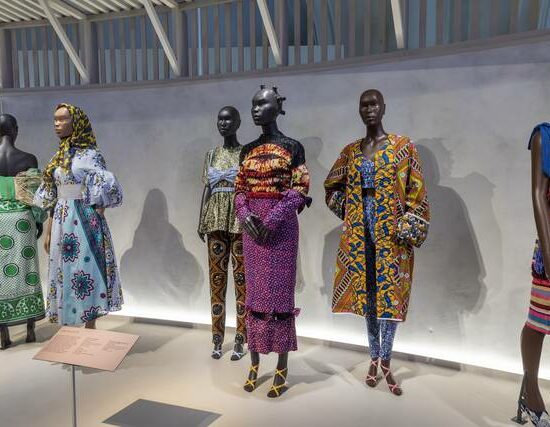
The flapper dress of the 1920s originated in Harlem. Dapper Dan pioneered the logomania trend that defines luxury fashion in 1980s New York. The concept of the modern runway, models walking rather than standing, was introduced by Black models at the Battle of Versailles in 1973. The zoot suit, the dashiki, streetwear as we know it, all have roots in Black culture that fashion history has consistently failed to credit.
Black models fought for decades to exist on runways and magazine covers from which they were systematically excluded. When Donyale Luna appeared on the cover of British Vogue in 1966, it was a landmark moment, and it should not have taken that long.
→ Read: History of Black Fashion Models
History of Black Women in Beauty
The modern beauty industry owes an enormous and largely unacknowledged debt to Black women. Madam C.J. Walker and Annie Turnbo Malone created the first mass-market haircare products for Black women in the early 1900s, building businesses worth millions at a time when Black women had almost no access to capital or commercial infrastructure.
In 1973, Eunice Johnson’s Ebony Fashion Fair became the platform that would eventually give rise to Fashion Fair Cosmetics, the first major beauty brand designed specifically for darker skin tones. When Rihanna launched Fenty Beauty in 2017 with 40 foundation shades, she was not inventing inclusion; she was finally forcing a mainstream industry to catch up with what Black women had been demanding for a century.
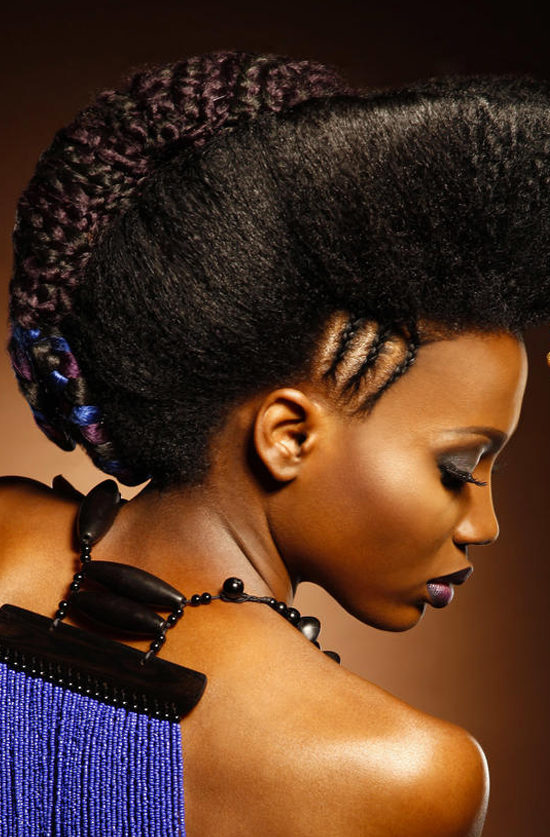
The natural hair movement, a cultural and political shift in Black women’s relationship with their hair that accelerated from the early 2000s, is perhaps the most significant beauty movement of the 21st century. It reclaimed afro-textured hair as beautiful, professional, and worthy of celebration. Its roots go back to the Black Power movement of the 1960s and 70s, when the Afro became a symbol of political resistance and cultural pride.
→ Read: History of Makeup for Black Women
→ Read: The History Cornrows
Black Women in Science — The Hidden Figures
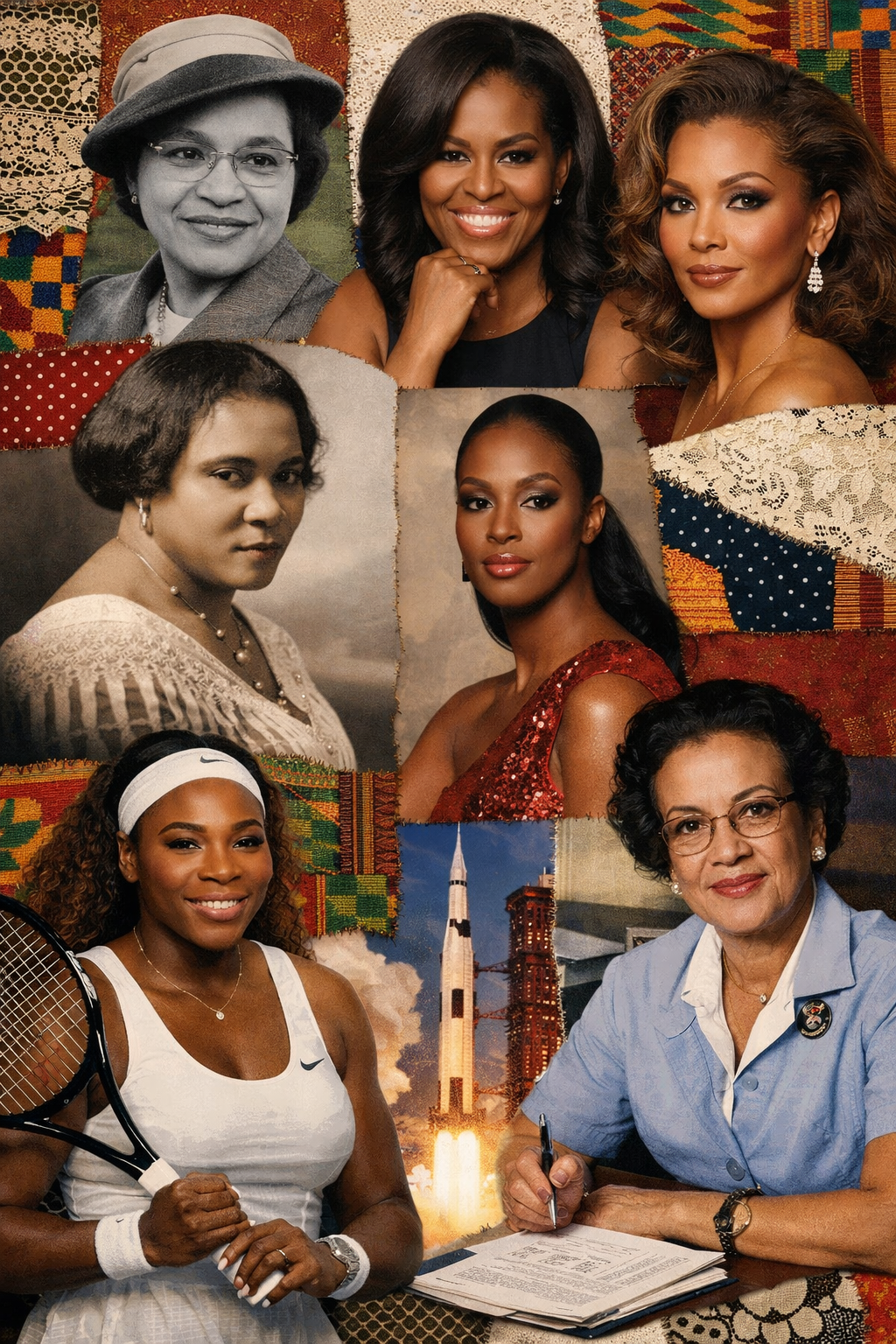
The term ‘hidden figures, popularised by the story of Katherine Johnson, Dorothy Vaughan, and Mary Jackson, the Black women mathematicians whose calculations were essential to NASA’s space programme, describes a pattern that extends far beyond NASA and far beyond America.
Throughout history, Black women’s intellectual and scientific contributions have been systematically overlooked, attributed to others, or simply not recorded. Alice Ball developed a groundbreaking leprosy treatment in 1915, and had her discovery claimed by a white male colleague after her death. Rebecca Lee Crumpler was the first Black woman to receive a medical degree in the United States in 1864, a fact that appears in almost no medical history textbooks. Shirley Jackson, the first Black woman to earn a PhD from MIT, made theoretical discoveries that underpinned the development of the fax machine, solar cells, and fibre-optic cables.
These are not exceptions. They are part of a pattern of extraordinary achievement that existed in parallel with, and despite, systemic exclusion.
→ Read: Black Scientists in History
Black Women in Art: Creating Visibility
Black women artists have faced a double barrier of race and gender that has kept them out of galleries, out of art history curricula, and out of the critical conversation for centuries. And yet they have created some of the most powerful, innovative, and culturally significant art of every era.
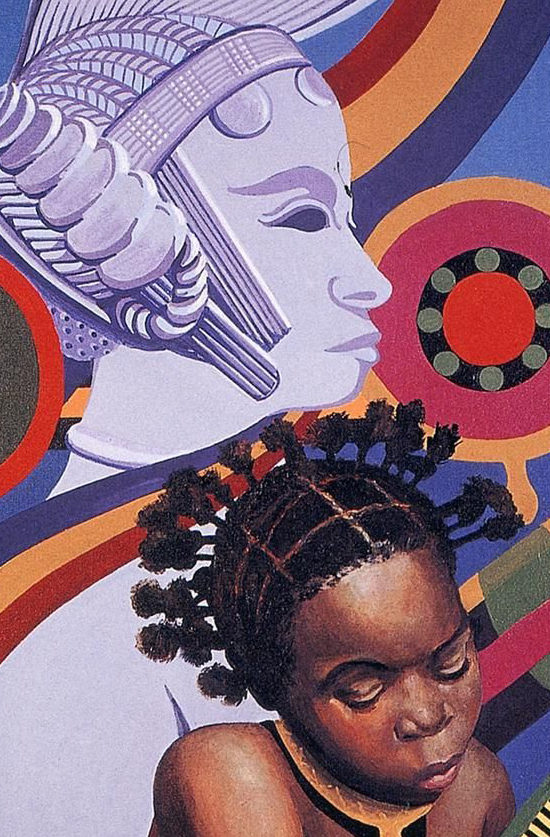
From the sculptors of pre-colonial Africa whose work informed modernism without attribution, to the Harlem Renaissance artists who created a visual language for Black identity in the 20th century, to the contemporary Black women artists who are now finally receiving the institutional recognition that was long withheld — the tradition is unbroken and extraordinary.
Augusta Savage, sculptor and teacher, whose work in the Harlem Renaissance shaped a generation of Black artists. Edmonia Lewis was the first professional Black sculptor, whose marble works challenged every convention of 19th-century America. Faith Ringgold, whose story quilts fused African textile traditions with activist art. Elizabeth Catlett, whose powerful prints and sculptures centred the experience of Black women with unflinching clarity.
→ Read: Famous Black Artists in History
African Heritage — Queens, Traditions, and Ancestral Knowledge
Before the transatlantic slave trade. Before colonialism. Before the histories that Western education recognises as ‘real history’, Black women were ruling kingdoms, managing trade routes, carrying ancestral knowledge, and building civilisations.
Queen Nzinga of Ndongo and Matamba (present-day Angola) spent four decades fighting Portuguese colonialism in the 17th century, negotiating as an equal with European powers, leading armies, and building strategic alliances that preserved her people’s autonomy. Yaa Asantewaa, Queen Mother of the Ashanti, led the War of the Golden Stool against British colonialism in 1900. Hatshepsut, pharaoh of Egypt for over 20 years, commissioned more monuments than any other pharaoh and built one of the most prosperous periods in Egyptian history.
African heritage also lives in the traditions that Black women carry across the diaspora, in hair practices, in food, in spiritual traditions, in the way community is built and maintained. Understanding where these practices come from deepens our appreciation of what they mean.
→ Read: History of African Yoga
→ Read: African Hair Threading — History and Tutorial
Black Culture and Traditions
History is not only what happened in the past, it is also the living traditions, celebrations, and cultural practices that connect Black communities to their roots and to each other.
Kwanzaa, created in 1966 by Maulana Karenga as a celebration of African heritage and community values, is one of the most significant examples of a Black cultural tradition born from historical consciousness. Its seven principles, Umoja (unity), Kujichagulia (self-determination), Ujima (collective work), Ujamaa (cooperative economics), Nia (purpose), Kuumba (creativity), and Imani (faith), articulate a vision of Black community life rooted in African values.
Understanding where cultural traditions come from, whether it is Kwanzaa, natural hair practices, African print fashion, or braiding techniques, enriches our experience of them and connects us to the long chain of Black women who carried these practices forward.
→ Read: African American Christmas and Kwanzaa History and Tradition
The Art of Black History
History lives not only in words but in images. My illustration collection includes figures and moments from Black history, Black women in historical and contemporary dress, cultural scenes, and the everyday beauty of Black life across the diaspora.
If you have found inspiration in this history guide, explore the illustration collection. Each print is a small act of visibility, a Black woman on a wall, in a home, in a child’s daily life. And the Black Women Colouring Book offers a creative way to engage with these images and share them with the next generation.
→ Shop the illustration collection