
Hair for Black Women: The Complete Guide
There is no topic in Black beauty more searched, more discussed, more politically charged, or more joyfully creative than hair. Black women’s hair sits at the intersection of culture, identity, history, and daily life in a way that no other beauty topic does.
It has been legislated against. Policed in workplaces. Fetishised by strangers. And at the same time, celebrated, innovated, protected, and worn as a crown.
This guide covers everything: the history, the science, the styles, the products, the salons, and the cultural conversations that make Black women’s hair so much more than just hair.
Understanding Black Hair -The Science
Black hair is structurally distinct from other hair types. The follicle shape is elliptical rather than round, which is why Black hair grows in a coiled or curly pattern rather than straight. The coiled structure means that natural oils produced by the scalp travel more slowly down the hair shaft, which is why Black hair tends to be drier than straight hair and requires more deliberate moisturising.
Understanding porosity is the single most useful framework for Black hair care. Low porosity hair has tightly closed cuticles that resist moisture but retain it once absorbed. High porosity hair has open or damaged cuticles that absorb moisture quickly but lose it just as fast. Most natural Black hair falls somewhere on this spectrum, and knowing where your hair sits determines everything from how you wash it to which products you choose.
Hair Types – A Useful Framework
The most widely used system is the Andre Walker hair typing scale, which categorises natural Black hair from 3C (loose curls) through 4A (tight coils) to 4C (the tightest coils with the least defined curl pattern). This system is imperfect, most Black women have multiple textures on one head, but it provides a useful starting vocabulary.
What matters more than your ‘type’ is understanding your hair’s specific needs: porosity, density (how many strands per square inch), strand width (fine, medium, or coarse), and scalp health.
Read: All You Need to Know About Afro Hair
Natural Hairstyles for Black Women – The Full Range
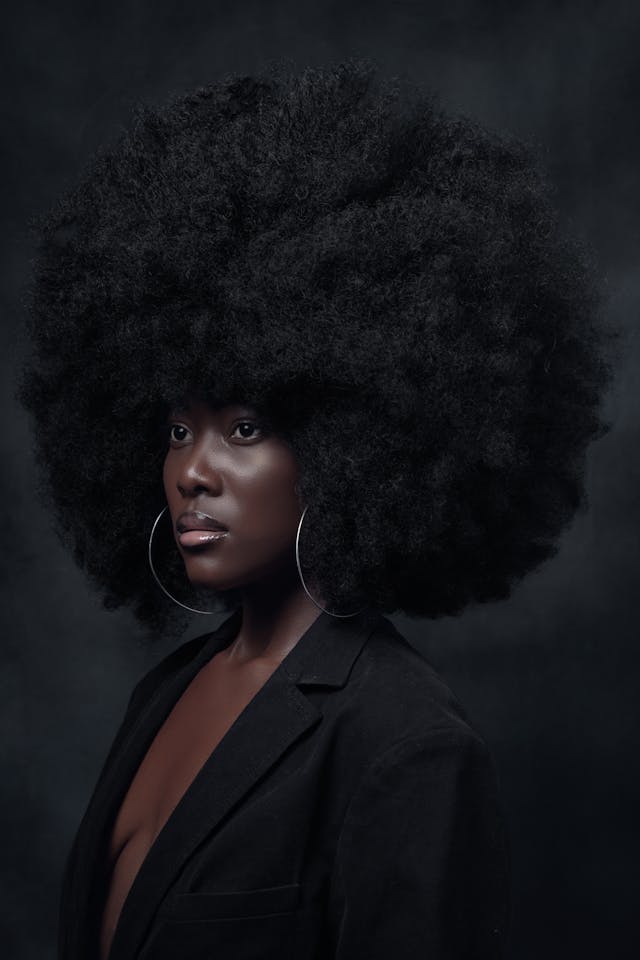
Black women’s natural hairstyles are one of the most creatively rich areas in all of beauty. From the elaborate braided architectures of West African tradition to the effortless twist-out, from the full magnificence of a well-defined afro to the sculptural elegance of locs — natural styling offers infinite creative possibilities.
Read: Best Summer Hairstyles for Black Women 2026
Protective Styles – History and Practice
Protective styles, braids, twists, cornrows, locs, threading, and other techniques that tuck away the ends of natural hair serve a dual purpose: they minimise daily manipulation (reducing breakage) and allow the hair to retain length. But they are also, in many cases, cultural practices with roots stretching back thousands of years.
Cornrows are perhaps the most iconic protective style with African origins. Archaeological evidence suggests cornrow-style braiding in Africa dates back at least 3,000 years. In pre-colonial West and Central Africa, hair patterns communicated social status, age, religion, and tribal affiliation. When enslaved Africans were brought to the Americas, they continued braiding, and some historians believe that braided hair maps were used to communicate escape routes on plantations.
Read: The History of Cornrows
African Hair Threading – A Living Tradition
African hair threading is a stretching technique that has been used across West, Central, and East Africa for centuries. The thread is wrapped around sections of hair to elongate and stretch the coil without heat, one of the earliest and most elegant heat-free styling methods. Today, it is experiencing a renaissance as natural hair enthusiasts rediscover ancestral techniques.
Read: African Hair Threading History and Tutorial
Traditional Styles from Across Africa
African hairstyling traditions vary enormously across the continent, each with its own techniques, meanings, and aesthetics. The work of photographers like J.D. Ojeikere, who documented Nigerian traditional hairstyles over five decades, gives us a visual archive of styles that might otherwise have been lost.
Read: Exploring Traditional Nigerian Hairstyles with Ojeikere
Hair Colour for Black Women
The world of hair colour for Black women has expanded enormously in recent years. From rich auburn and chestnut browns that warm dark skin beautifully, to bold coppers and gingers that have become signature looks, to blonde that requires careful technique but creates stunning results, colour opens a new dimension of creative expression for Black women’s hair.
Key consideration: colour-treated hair requires a modified care routine. Colour raises the hair cuticle, increasing porosity and the tendency to dryness. Deep conditioning becomes non-negotiable, protein treatments help maintain strand integrity, and colour-safe products protect your investment.
Protecting Your Hair – Seasonal and Activity-Based
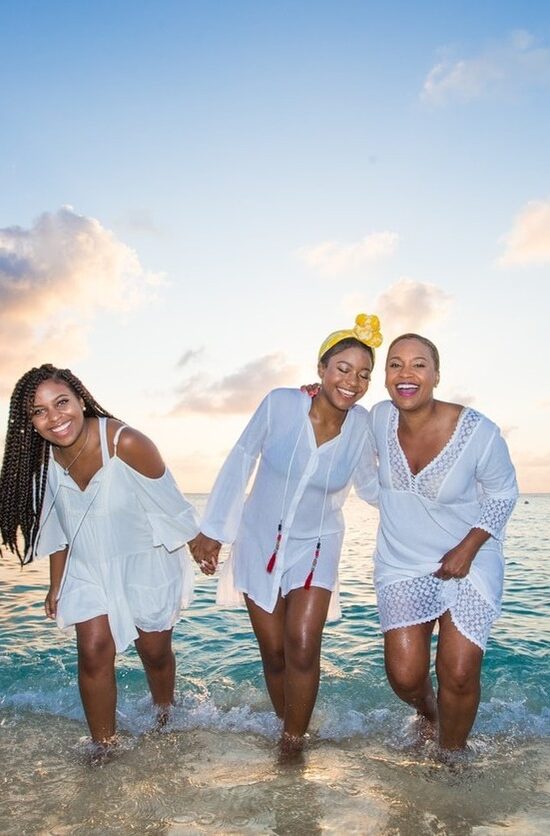
Black hair requires specific protection in certain environments and seasons. Summer presents the triple challenge of UV exposure, saltwater, and chlorine, all of which can seriously damage natural hair. The right approach is not to avoid summer activities but to prepare your hair properly before and repair it effectively after.
Read: Protecting Your Natural Hair from Sun, Sea and Pool
Black Women’s Hair Through History
Black women’s hair has been at the centre of culture, politics, and identity for centuries. In the 1920s, the Harlem Renaissance celebrated natural Black aesthetics. In the 1960s and 70s, the Afro became a powerful symbol of Black Power and political resistance. In the 1980s and 90s, relaxers and perms dominated, products that straightened natural coils to conform to Eurocentric standards. And in the 2000s and 2010s, the natural hair movement reclaimed the coil, the curl, and the loc as beautiful, professional, and worthy.
Today, the CROWN Act in the United States, legislating against hair discrimination in workplaces and schools, is the most recent chapter in this long political history.
Finding the Right Salon – Including in Paris
For Black women in Paris or elsewhere in France, finding a stylist who genuinely understands natural Black hair has historically required significant effort, and sometimes disappointing results. The good news is that the Afro hair salon scene in Paris has grown substantially, with skilled stylists who specialise in natural hair, loc maintenance, braiding, and protective styling.