
Ancient African Clothing: What People Wore Before European Contact
One of the most persistent myths about Africa is that its people had no fashion before European contact, that dress was minimal, unsophisticated, or merely functional. This myth is not just wrong. It is a colonial fabrication designed to justify the idea that Africa required ‘civilising.’
The archaeological and historical record tells an entirely different story. For thousands of years before any European set foot on African soil, the continent’s peoples had developed some of the world’s most sophisticated textile traditions, weaving, dyeing, embroidering, beading, and crafting garments of extraordinary beauty and cultural complexity.
This article explores what ancient Africans actually wore: the materials they used, the techniques they mastered, and the cultural meanings encoded in every thread.
Clothing in Ancient Egypt: The Foundation of African Fashion
Linen and the White Ideal
Ancient Egypt, one of the world’s earliest and most sophisticated civilisations, developed a fashion culture that would not look out of place in a contemporary minimalist collection. The primary fabric was linen, woven from flax grown along the Nile. Egyptian linen was extraordinarily fine, some of the finest woven textiles ever discovered in the ancient world.
White was the dominant colour for most garments, particularly for the elite. It symbolised purity, divinity, and refinement. The quality and fineness of a person’s linen communicated their status immediately. A pharaoh’s garments were near-transparent; a labourer’s were rough and unbleached.
Garment Forms and Social Hierarchy
Egyptian dress forms were deceptively simple in structure but extraordinarily rich in detail. Men typically wore a schenti, a linen loincloth or kilt, wrapped around the hips. Women wore a straight sheath dress called a kalasiris, often secured over one or both shoulders. Pleating, achieved by hand-pressing wet linen into accordion folds, was a mark of status and skill.
What elevated Egyptian dress beyond the garment itself was the culture of accessories. Broad collars (wesekh) made from gold, faience beads, and semi-precious stones were worn by both men and women of rank. Elaborate wigs of human hair or plant fibre, kohl-lined eyes, and gold jewellery completed an aesthetic that was simultaneously regal and intensely personal.
Priestly and Royal Dress
Certain garments in ancient Egypt were exclusively ritual. High priests wore leopard-skin robes over their white linen. The pharaoh’s ceremonial regalia — the double crown, the crook and flail, the false beard — was a complete semiotic system, communicating divine authority through every element. Dress was not fashion in the modern sense: it was cosmology made visible.
Sub-Saharan Africa: Natural Fibres and Body as Canvas
Bark Cloth: Africa’s Oldest Textile
One of the oldest textile traditions in the world is bark cloth, still practised by the Buganda people of Uganda and listed by UNESCO as an Intangible Cultural Heritage. Made by pounding the inner bark of specific fig trees (Ficus natalensis) until it becomes soft and pliable, bark cloth was used across Central and East Africa for clothing, bedding, and burial shrouds.
The process is labour-intensive and ecologically sensitive — the same tree can be harvested repeatedly without killing it, a form of sustainable textile production that predates the term by millennia. Different communities developed distinctive methods of colouring and decorating bark cloth, using plant-based pigments, geometric printing, and cut-out patterns.
Raffia Textiles: The Art of the Kuba Kingdom
Among the most sophisticated pre-colonial textiles anywhere in the world are the raffia cut-pile cloths of the Kuba Kingdom of the present-day Democratic Republic of Congo. The Kuba (also known as the Shoowa) wove raffia palm fibres into cloth and then used a knife to cut patterns into the pile, creating a velvet-like surface of extraordinary intricacy.
Kuba cloth designs are strikingly modern in their sensibility, bold geometric patterns, asymmetric arrangements, and infinite variation within a strict formal grammar. When Kuba cloth was first seen by European designers in the early 20th century, it directly influenced the development of Art Deco. Pablo Picasso reportedly kept a piece in his studio. These designs were not naive folk art — they were the product of a highly developed aesthetic tradition.
Natural Dyes and Their Cultural Significance
Across sub-Saharan Africa, dyeing was not merely a technical process; it was often a spiritual one. The most significant natural dye was indigo, produced from the Indigofera plant. Indigo dyeing was practised across West Africa and became associated with specific communities and trades. Among the Yoruba of Nigeria, indigo-dyed adire cloth — made using a resist-dyeing technique involving cassava paste or tied fabric — developed into a sophisticated art form.
In West Africa, the colour and pattern of a garment were rarely arbitrary. Different occasions demanded different colours: white for mourning in some communities, red for warriors, blue-black for ceremonies. The visual grammar of dress was a shared language within communities — and a source of mystery and power to outsiders.
West Africa in Ancient Times
The Mali Empire and Textile Traditions
The Mali Empire (c. 1235–1600) was one of the wealthiest states in the medieval world, controlling the trans-Saharan gold and salt trade. Its capital Timbuktu, was a centre of Islamic scholarship and commerce, and fashion. Accounts by Arab travellers describe the elaborate dress of the Malian court: fine cotton robes, silk garments imported from North Africa and the Middle East, and gold accessories of staggering quantity.
Under the Mali Empire, cotton weaving became an industry. The Mande-speaking peoples of the Sahel developed a tradition of strip-woven cloth — narrow strips woven on a portable horizontal loom and then sewn together to make larger garments. This technique, still practised across West Africa today, produces cloth with a distinctive texture and visual rhythm.
Bogolan: The Mud Cloth of Mali
Perhaps the most internationally recognised ancient African textile is bogolan, mud cloth. Made by the Bamana people of Mali, bogolan is a cotton fabric dyed through a complex process: first soaked in a solution made from boiled leaves (which creates a yellow ground), then painted with fermented mud using a wooden spatula, then bleached back to create the final geometric patterns in white, beige, and black.
Each bogolan pattern has a name and a history. Many designs are linked to specific hunters’ associations, specific clans, or specific historical events. A skilled bogolan maker is not merely a craftsperson — they are a historian, a storyteller, and a keeper of cultural memory.
Kente: The Royal Cloth of the Ashanti
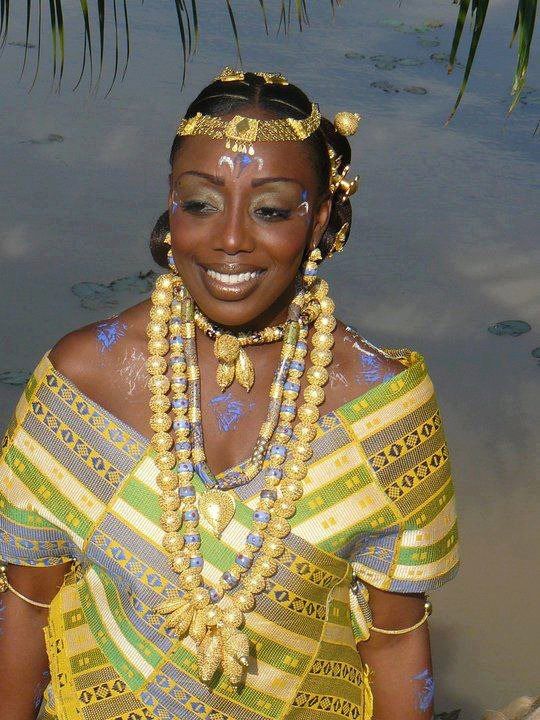
Kente cloth, woven by the Ashanti people of present-day Ghana, is one of the most recognisable textiles in the world. Its origin story, as told by the Ashanti, involves two men who observed a spider weaving its web and taught themselves to replicate the technique. Whether legend or history, kente weaving became one of the most prestigious crafts in Ashanti culture.
Traditional kente is woven on a narrow strip loom, with the strips sewn together to make a large cloth wrapped around the body. Every colour and every pattern has a specific meaning: gold signifies royalty and wealth; blue, love and harmony; red, political tension and bloodshed; green, growth and renewal. Certain patterns were reserved exclusively for the Asantehene (the Ashanti king) and could not be worn by commoners.
East Africa: Coastal Trade and the Kanga
East Africa’s position on the Indian Ocean trade routes created a textile culture unlike anywhere else on the continent. Arab, Persian, Indian, and later Chinese merchants traded along the Swahili Coast, bringing cotton, silk, and new dyeing traditions. Local textile production absorbed and transformed these influences.
The Kanga emerged from this milieu. Originally plain white cotton, it was transformed by the demands of East African women who wanted colour and pattern. By the late 19th century, Kanga manufacturers (initially based in India, printing for the East African market) were producing the distinctive bordered design with a central image and a printed Swahili proverb. The proverb was the key innovation; it made the cloth speak.
Kanga is still worn across East Africa today. A woman’s choice of Kanga, and especially her choice of proverb, communicates messages to those who know how to read them. It can express joy, send a warning, offer comfort, or deliver a pointed message to a rival, all without a word being spoken.
Southern Africa: Zulu Beadwork and Ndebele Adornment
The Language of Zulu Beads
The Zulu people of present-day South Africa developed one of the world’s most sophisticated systems of non-verbal communication through beadwork. Zulu beadwork uses a specific colour code — different colours carry different meanings, and combinations of colours communicate complex messages. A young woman might send a beaded love letter to a man; the arrangement of colours would communicate whether her feelings were returned or whether she was expressing disappointment.
This system was not written down — it existed as shared cultural knowledge within communities. It is one of the most striking examples of dress as language: not metaphorically, but literally.
Ndebele Body Painting and Ornamental Dress
The Ndebele people — found in both South Africa and Zimbabwe — are known across the world for their extraordinary visual culture: brightly painted geometric designs on houses, and elaborate beaded costumes for women that include neck rings (called idzila), beaded blankets, and aprons whose specific forms communicate a woman’s age and social status.
A young Ndebele girl’s costume is different from a married woman’s, which is different from a grandmother’s. The costume changes with life stages, and each transition is marked by a ceremony. Dress here is not merely aesthetic — it is the visual record of a life.
What Ancient African Clothing Tells Us About Society
Looking at the textile traditions of ancient Africa reveals something fundamental: these were not simple or primitive cultures. They were complex, stratified, creative societies in which dress served as a sophisticated social technology.
African clothing communicated social rank, instantly and precisely. It communicated spiritual standing, tribal affiliation, life stage, and political allegiance. It encoded history and mythology. It served protective functions, spiritual as well as physical. And it was beautiful. The artisans who created these garments were not anonymous craftspeople; in many cultures, they were among the most respected members of society.
Understanding this is not merely historical. It is essential context for understanding why African fashion continues to be so charged with meaning, why wearing Kente cloth or Bogolan or Kanga is never just a fashion choice, but an act of cultural affirmation.
Ancient African clothing was sophisticated, meaningful, and breathtakingly diverse. From the fine linen of Egyptian pharaohs to the beaded love letters of Zulu women, from the velvet-pile cloths of the Kuba Kingdom to the proverb-printed Kanga of the Swahili Coast — Africa’s pre-colonial textile heritage is one of the great artistic achievements of human civilisation.
The colonial myth of an Africa without fashion is not just historically wrong. It was a deliberate erasure of a tradition that threatened the supposed cultural superiority of European civilisation. Recovering this history is an act of justice — and an essential foundation for understanding African fashion today.
Previous article: The History of African Fashion