


How to Create a Comic Book or a Graphic Novel Step 1: Writing a Story
Comic books are attracting millions of new readers each year, and with them, a new wave of writers and artists eager to bring their own stories to life. This format offers extraordinary creative freedom: no production budget, no casting constraints, no limits on the imagination. A single skilled writer can introduce readers to an entirely new universe.
But designing a compelling comic is a long-term endeavour that demands mastery of multiple disciplines, storytelling, visual thinking, character psychology, and structural craft. This guide walks you through Step 1: writing the story that will carry your comic book from concept to finished page. In many cases, scriptwriting for comic books is entrusted to professional authors who specialise in the format. If you are working on a niche project, an online dating comic, a workplace satire, or a personal memoir in graphic novel form, developing a compelling story with emotionally relatable characters is essential to engaging your audience from the very first panel.
Step 1: Finding Your Story Idea
Every compelling story starts with something emotionally true. Before you reach for genre tropes, dig into your own memory. The richest ideas are often hiding in plain sight — in childhood summers, in family tensions, in the jobs you hated and the ones you loved. The following brainstorming exercise will help you locate them.
| Brainstorming Exercise List freely in each category below. Write quickly, without judgment. You are looking for emotional charge, not narrative logic that comes later. |
List at least 5 entries per category:
- 5 people or things from childhood that still feel significant
- 5 foods that bring back strong memories
- 5 family members you knew very well
- 5 family members you never really got to know
- 5 activities you loved as a child
- 5 activities that defined your teenage years
- 5 things you love doing right now
- 5 summer or temporary jobs you held in school or college
- 10 things you talked about with friends last week
- 10 things that made you angry this week, 10 things that pleased you
- 5 figures from history you admire or feel a creative affinity for
- 10 moments in your life that change you
| From List to Mind-Map After completing your lists, read through them slowly. Circle the word or phrase that produces the strongest emotional reaction, not the most ‘interesting’ one to others, but the one that makes you feel something. That word becomes your seed. From it, build a mind-map or spider diagram: write the seed word in the centre and let it branch freely into images, people, places, and memories. No wrong answers. The unconscious mind is a better story engine than the logical one. |
Step 2: Creating Your Main Character
Memorable comic book characters are specific, not ‘brave,’ but ‘recklessly loyal even when it destroys her.’ Write a list of at least 8 distinct characteristics for your protagonist. The most powerful character profiles mix psychological traits with physical ones that directly affect the story world.
Physical and psychological traits to consider:
| Shy / deeply introverted | Recklessly loyal |
| Aggressive or impulsive | Physically imposing or unusual |
| Intellectually arrogant | Emotionally numb |
| Pathologically suspicious | Possessing a superpower or disability that shapes daily life |
| Key Technique: Show, Don’t Describe Once you have your full list, identify the single most dominant trait. That characteristic is your character engine, the force that drives every scene they inhabit. Draw a short sequence of 3 to 6 panels that illustrates this trait through behaviour, expression, and consequence. Do not describe it in narration. Show it. |
Step 3: Comic Book Story Structure — The Three-Act Framework
Story structure is not a cage, it is a launchpad. Understanding the three-act model gives your narrative momentum, contrast, and emotional resolution. Most great comic books and graphic novels, from Watchmen to Saga, from Maus to Persepolis, are built on this foundation, even when they appear to subvert it.
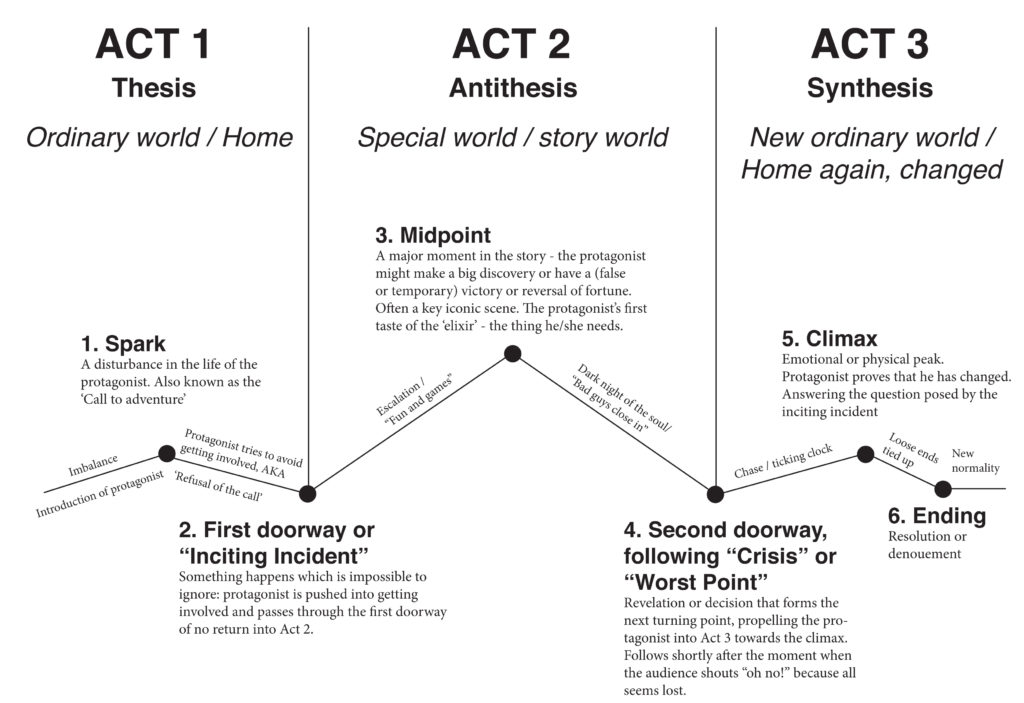
Creating the structure is the baseline from which you write your full scenario. The three-act framework divides your story into thesis, antithesis, and synthesis. Think of it as the essential architecture before you add any walls, windows, or doors.
| ACT I Thesis The character’s core belief about the world, what matters most to them right now. | ACT II Antithesis The world that violently contradicts that belief, the most hostile environment for this character. | ACT III Synthesis How thesis and antithesis collide, and what survives. The character transformed. |
Act I – The Thesis: Establishing the World That Is
Ask yourself: what does my character believe is the most important thing in life? Family above all. Freedom at any cost. Justice, even when it is cruel. Truth, no matter who it hurts. This belief defines their motivation and gives readers an emotional stake before a single conflict begins.
The ‘ordinary world’ of Act I is not boring, it is the world that makes sense to your protagonist. It is where we understand who they are, what they value, and what they stand to lose. Every element you establish here should pay off in Acts II and III, when that world is turned upside down.
| Act I – Key Question What is the most important thing in the world to your character, right now? Define this belief as precisely as possible — it is the thesis your entire story will test. |
Act II – The Antithesis: The World That Isn’t
This is your story’s engine. The antithesis is not simply a dangerous setting; it is a world that specifically, surgically attacks everything your character believes. A character who values rigid order should be thrown into radical chaos. A character who prizes isolation should be forced into radical interdependence. A character who believes in human goodness should be confronted with its absolute absence.
Act II is the longest and most demanding act to write. This is where the character is tested, broken down, and rebuilt. The antithesis world is the most uncomfortable, alien, or nightmare environment your character could inhabit, not by accident, but by the internal logic of the story.
| Act II – Key Question What is the most uncomfortable, alien, or nightmare world this character could be forced to inhabit? The answer to this question IS your Act II. Design it with the thesis in mind — the world must attack the belief directly. |
Act III – The Synthesis: Reconciliation and Resolution
Act III is where your story earns its ending. The synthesis does not require a happy resolution; it requires an honest one. Your character has been forged by the collision of their belief (thesis) and its antithesis. What survives that collision? What is destroyed? What becomes something entirely new?
In the best comic books and graphic novels, the synthesis reveals something profound about the human condition. The ending does not simply resolve the plot; it reveals what the character was truly made of all along. Aim for that. Do not settle for survival of the narrative. Strive for the transformation of the character.
| Act III – Key Question How can the thesis and antithesis be reconciled, or not? What version of your character emerges from the collision? This is the question your entire story has been building toward. Answer it honestly. |
Detailing Your World for the Artist
Once the outline of your story has been defined, take care to detail your world and characters as fully as possible. Your artist collaborator, whether that is someone else or a future version of yourself, needs to be able to see what you imagined.
Document the following for every major element:
- Geography and physical environment: where does the story take place, and how does the landscape shape the characters?
- Architecture and visual style: what do buildings, interiors, and objects look like in this world?
- Culture and social rules: what are the unwritten laws of this world?
- Character appearance: not just clothes, but posture, expression, how they occupy space
- History and backstory: what happened before the story begins, even if it is never shown on the page?
- Visual metaphors: are there recurring images, symbols, or motifs that carry meaning?
Writer’s Checklist: Step 1 Complete
Use this checklist to confirm you have completed the foundational story work before moving on to Step 2: The Storyboard.
| ☐ | Brainstorming lists completed (all 12 categories) |
| ☐ | Seed word identified from the lists |
| ☐ | Mind-map or spider diagram completed from seed word |
| ☐ | Main character trait list written (minimum 8 traits) |
| ☐ | Dominant character trait identified |
| ☐ | Short illustrative sequence drawn (3-6 panels showing dominant trait) |
| ☐ | Act I thesis defined: core belief documented |
| ☐ | Act II antithesis designed: nightmare world described |
| ☐ | Act III synthesis outlined: resolution or transformation noted |
| ☐ | World details documented for the artist |
| ☐ | Supporting characters noted with key traits |
| ☐ | Visual motifs or recurring symbols identified |
NEXT: STEP 2 — THE STORYBOARD
How to Create a Comic Book: Create a Storyboard
With your story outline locked in, the next step is to translate your written narrative into visual sequences. The storyboard is where your words become comic panels, where pacing, panel composition, and visual storytelling begin. Step 2 covers panel layout, page structure, working with artists, and the transition from script to sequential art.